
B-PHOT Review Highlights Transformative Power of Deep Learning Across the Optical System Workflow

B-PHOT researchers are proud to announce the publication of a high-impact review article in IOP Publishing’s Journal of Physics: Photonics (Impact Factor 8.4). The paper provides a definitive guide to how Artificial Intelligence is reshaping the future of optical engineering.
The review, titled "Deep learning across optical system workflow: A comprehensive review from design to assembly," offers a holistic perspective on the integration of Deep Learning (DL) throughout the entire lifecycle of an optical system —a field where B-PHOT continues to demonstrate international leadership.
Deep learning across optical system workflow: A comprehensive review from design to assembly
A Paradigm Shift in Optical Engineering
As optical systems become essential to technologies like autonomous driving and medical imaging, traditional manual design iterations are reaching their limits. B-PHOT addresses this challenge through a synergy of physical modeling and data-driven intelligence —a vision recently featured in the Optica OPN News, "AI Opens Up Optical System Design," for its success in streamlining labour-intensive design cycles.
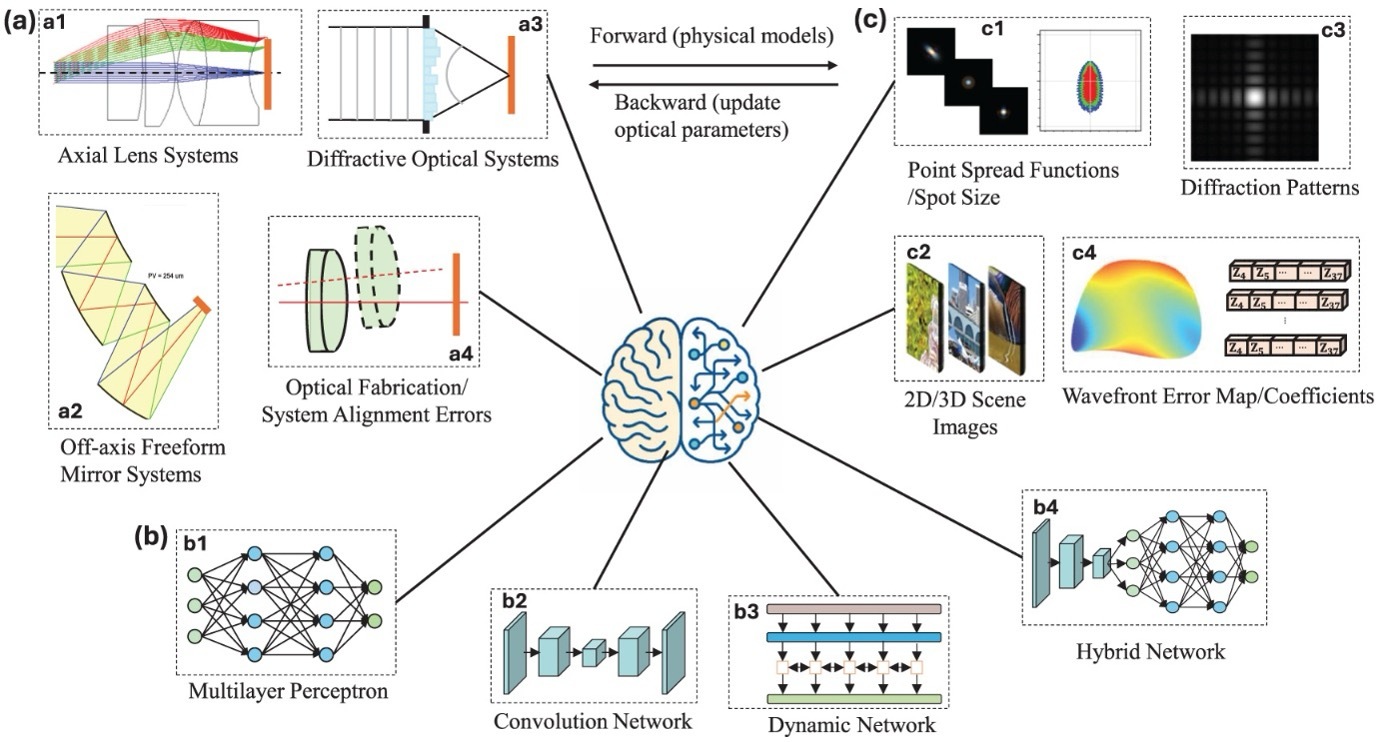
Rather than looking at isolated components, the review article further provides a comprehensive roadmap of DL applications across three critical pillars:
- Design Acceleration: Accelerating the discovery of complex lens configurations and metasurfaces through inverse design, moving beyond traditional manual heuristics.
- End-to-End Optimization: Co-optimizing physical hardware and digital algorithms as a single unit. This paradigm shift allows for tailored optical systems that prioritize task-specific performance (such as object recognition or depth sensing), enabling hardware simplification and significantly lower physical constraints without sacrificing precision.
- Intelligent Assembly: Revolutionizing the "end-of-the-line" process by integrating computer vision and reinforcement learning. This ensures sub-micron alignment and automated testing, bringing unprecedented efficiency to the manufacturing floor.
Bridging Theory and Industry
The significance of this review lies in its practical outlook. It addresses the industry's most pressing challenges—such as data scarcity and model interpretability—while highlighting how "AI + Photonics" can drastically reduce time-to-market for next-generation devices. By establishing these benchmarks, B-PHOT reinforces its role as a key driver in the digitalization of the photonics industry.
"Our goal is to lower the barriers to entry for AI in high-precision optics by equipping intelligent systems with a fundamental understanding of optical physics," says Prof. Yunfeng Nie. "We are moving toward a future where AI handles the repetitive and intricate optimizations—from task-specific lens design that enables hardware simplification to intelligent assembly. This allows engineers to transcend routine design cycles and focus on substantive innovation while achieving unprecedented hardware efficiency."
👏 Congratulations to all co-authors: Yunfeng Nie, Runmu Su, Simon Thibault, Menke Christoph, Jürgen Van Erps, Hugo Thienpont and Heidi Ottevaere.