
Pablo Marin‑Palomo Joins B‑PHOT Professor Team

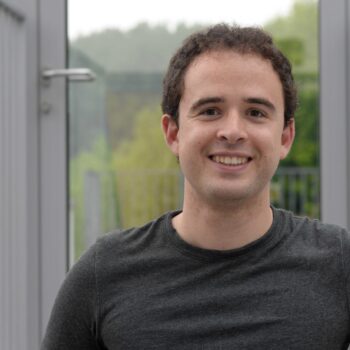
Pablo Marin-Palomo is joining the professor team of B-PHOT. With this new appointment, he strengthens the research and innovation capacity of the B-PHOT Brussels Photonics group at the Vrije Universiteit Brussel (VUB). A passionate and forward‑looking researcher, Prof. Marin-Palomo aims to advance integrated photonic technologies for next‑generation optical and THz communications, combining high system performance with reduced cost, footprint, and energy consumption.
“I’m truly excited to take on this position. It’s a major step in my career, and I wouldn’t have reached it without the support of my supervisors at B-PHOT, who helped me grow as a researcher and take on new responsibilities, and the unconditional support of my family,” says Prof. Marin-Palomo. “This appointment gives me the momentum to push my research to the next level.”
Prof. Marin-Palomo outlines a clear research vision: “My aim is to bring novel integrated photonic technologies into next-generation optical and THz communications, pushing system capacity while reducing cost, footprint, and energy consumption. In particular, I see THz photonics becoming highly relevant over the next two decades, and I’m eager to help drive that field forward.”

With this appointment, he plans to secure competitive funding to establish his own research group. “I’m excited to build a team of motivated and exceptional PhD researchers and postdocs so we can tackle ambitious problems together and deliver high impact results,” he adds. “I also look forward to strengthening collaborations with other professors at B‑PHOT. B‑PHOT’s unique ecosystem, spanning fundamental research to industrial realization, is the ideal place to translate integrated photonic technologies from lab concepts to real‑world applications.”
Image © Thierry Geenen
Pablo Marin-Palomo
Prof. Pablo Marin-Palomo (15-02-1990) is a research professor at the Faculty of Engineering of the Vrije Universiteit Brussel (VUB). Pablo received his B.S. degree in Physics from the Universitat Autònoma de Barcelona (UAB, Spain) in 2012 and obtained his master’s degree in Optics and Photonics from the Karlsruhe Institute of Technology (KIT, Germany) in 2014. Immediately after, he joined the Institute of Photonics and Quantum Electronics (IPQ, KIT, Germany) in the group of Prof. Christian Koos to work on “massively-parallel coherent communications with integrated frequency comb sources” and “integrated photonic-assisted ADC”.
He obtained his PhD in 2021 from KIT, and moved to Belgium (VUB) to join the B-PHOT team in the group of Prof. Virte to develop on-chip multi-wavelength laser sources for THz photonic filters for THz communications. In 2023, he was awarded the FWO junior postdoctoral fellowship, with the aim of combining frequency combs and multi‑wavelength technologies for THz applications. His research interests include photonic integration, nonlinear optics, frequency comb technologies, and optical and THz communications.
Related People
Other News in Research
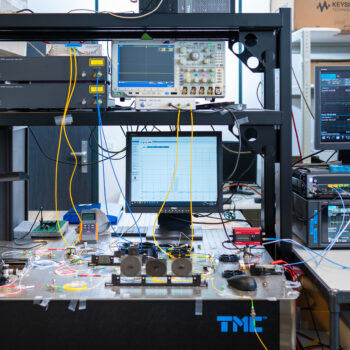
ERC Starting Grant for VUB B-PHOT Researcher Pablo Marin-Palomo
New project COMBYNE will use networks of interacting lasers on a single chip to generate flexible, energy-efficient frequency combs for future optical and terahertz communication.

B-PHOT Research on Scalable SERS Substrates via Triboelectrification Featured in Small Methods
Exploring triboelectrification-driven self-assembly as an accessible route to high-performance SERS sensing substrates.

B-PHOT Key Partner for Optics and Quantum Technologies in FWO Einstein Telescope Consortium
B-PHOT has joined the FWO ET-TECH consortium to develop high-precision optics and quantum technologies for the Einstein Telescope. This collaboration aims to push the sensitivity of Europe's future gravitational-wave observatory beyond current limits.