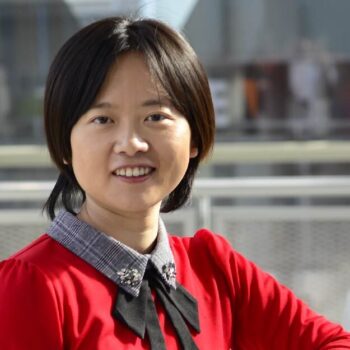
Prof. Yunfeng Nie from B‑PHOT Receives the 2026 Kevin P. Thompson Optical Design Innovator Award

Brussels Photonics (B-PHOT), Vrije Universiteit Brussel (VUB), is proud to announce that Prof. Yunfeng Nie has received the 2026 Kevin P. Thompson Optical Design Innovator Award, presented by Optica.
The award recognises significant contributions to lens design, optical engineering, or metrology by an individual within ten years of completing their highest degree. Established in memory of Kevin P. Thompson, who made important advances in the understanding of aberration fields in nonsymmetric and freeform optical systems, the award honors researchers whose work meaningfully advances the discipline at an early stage of their careers.
Prof. Nie is recognized for her pioneering contributions to freeform optical system design and AI-driven, physics-aware optical engineering methodologies that bridge classical optical theory with modern deep learning frameworks.
Upon receiving the award, Prof. Nie stated:
“I am deeply honored to receive the 2026 Kevin P. Thompson
Optical Design Innovator Award. I am grateful to my mentors, colleagues,
and collaborators whose support has been essential throughout this
journey.”

More information about this award can be found in the official OPTICA press release
Research Highlights
Prof. Nie’s research centers on freeform optical system design and the integration of physics-based modeling with modern computational approaches.
A central theme of her recent work is the development of generalized differentiable models for complex optical systems. This includes differentiable three-dimensional ray tracing for freeform optics and unified ray–wave formulations for refractive–diffractive hybrid systems, enabling end-to-end modeling and optimization across geometric and wave regimes.
She has further explored learning-based strategies for aberration correction and depth-aware point spread function modeling, improving imaging performance in compact and miniature optical platforms.
At the system level, her research demonstrates how advanced modeling and design strategies translate into miniaturized high-performance optical architectures, including freeform-based confocal detection systems and high-numerical-aperture fluorescence platforms for sensitive bioanalytical applications.
More recently, she led an invited comprehensive review synthesizing how deep learning is influencing the optical system workflow from design to assembly and alignment.