
ERC Starting Grant for VUB B-PHOT Researcher Pablo Marin-Palomo
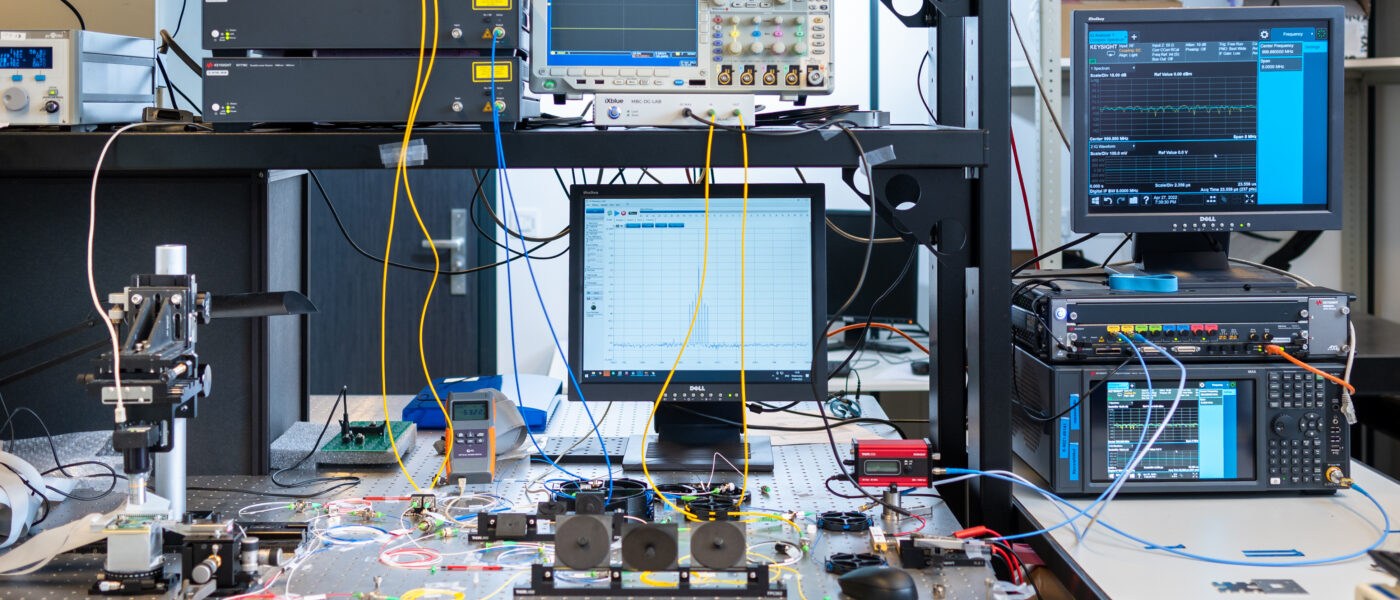
The new VUB B-PHOT project COMBYNE will explore how networks of interacting semiconductor lasers can generate and manipulate many colours of light together on a single photonic platform. The research could lead to compact and energy-efficient photonic engines for future optical and terahertz communication systems.
Prof. Dr. Pablo Marin-Palomo, researcher at Vrije Universiteit Brussel (VUB) and B-PHOT Brussels Photonics, has been awarded a European Research Council (ERC) Starting Grant for COMBYNE. Over the next five years, he will leverage the interaction between multiple lasers on a single chip to generate a flexible frequency comb on a monolithic platform. The ambition is to establish a new class of compact photonic engines for future optical and terahertz communication systems.
A network of lasers on a single chip
At the heart of COMBYNE is the optical frequency comb. While lasers typically produce only one colour of light, an optical frequency comb source generates dozens or even hundreds of evenly spaced colours. Frequency combs have applications in metrology, spectroscopy and optical and terahertz communications. In a communication system, each colour can carry a separate stream of data, allowing one compact light source to support many parallel channels. This could help communication systems accommodate rapidly growing data traffic while limiting their energy consumption.
While these applications would benefit from compact, reconfigurable frequency comb sources that can be manufactured at scale, current sources are still mostly based on multi-platform integration, since monolithic frequency comb sources can face limitations in bandwidth and coherence. In addition, frequency combs face a long-standing trade-off between bandwidth and flexibility: broadband frequency combs are challenging to tune, while reconfigurable frequency combs are limited in bandwidth.
With COMBYNE, Marin-Palomo will realise a programmable optical frequency comb source on a monolithic platform by harnessing the nonlinear dynamics of mutually coupled semiconductor lasers
"The core idea is to turn the interaction between lasers into an advantage," Marin-Palomo explains. "We want to understand those interactions deeply enough to engineer them.”
The project will study networks of coupled semiconductor lasers and investigate how their collective dynamics can be used to engineer a reconfigurable optical frequency comb. COMBYNE will connect fundamental laser physics, photonic-chip design and high-speed communication experiments. The team will first identify and understand useful dynamical regimes, then translate those findings into integrated photonic devices. The most promising concepts will subsequently be tested using high-speed data signals.
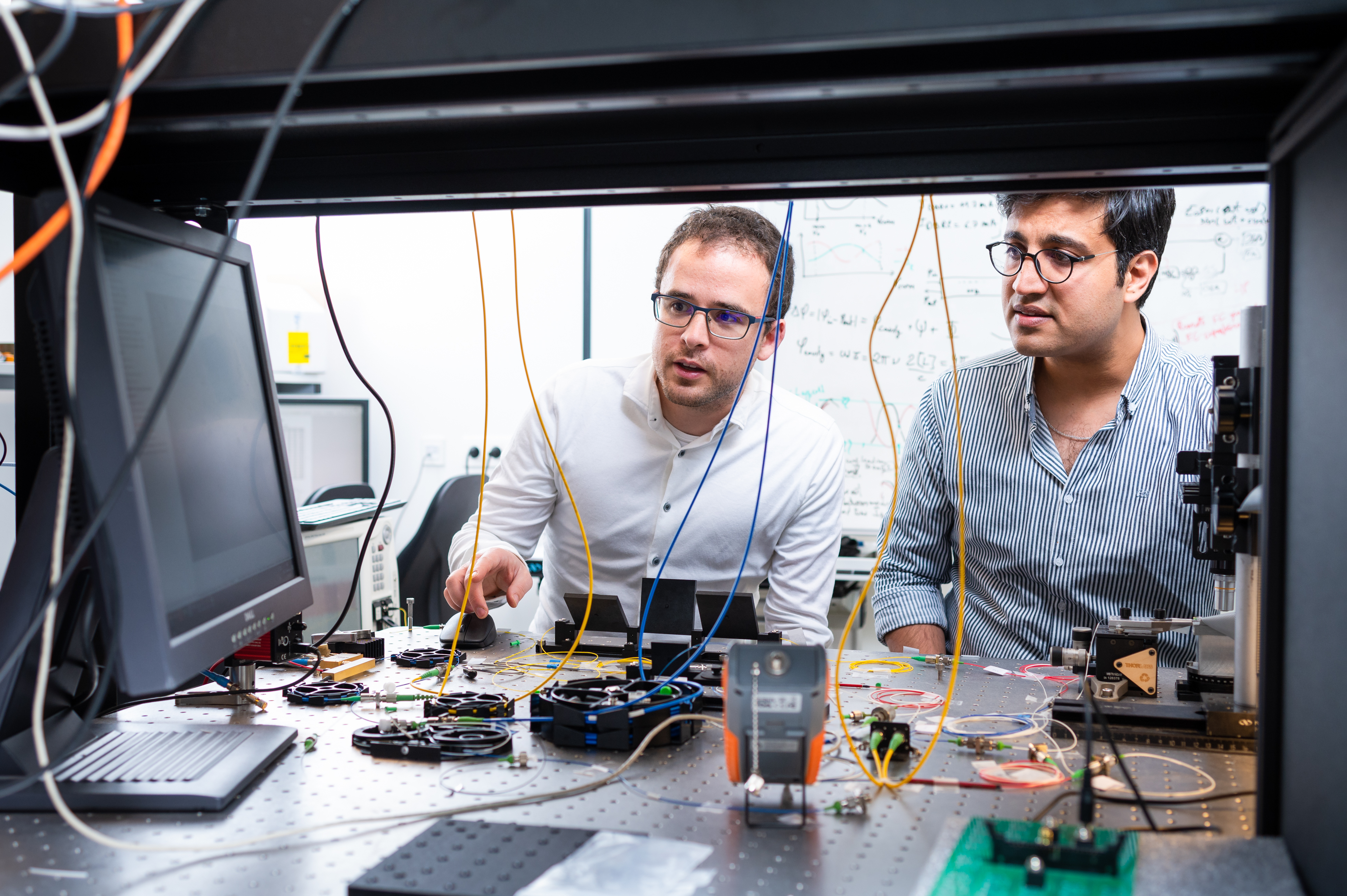
© Thierry Geenen
Building a new team at B-PHOT
The ERC Starting Grant will enable Marin-Palomo to establish a dedicated COMBYNE team at VUB B-PHOT and to develop the models, integrated photonic devices and experiments required for the project.
"Receiving this award is both an honour and a responsibility,” he says. “It gives us the opportunity to build a dedicated team, develop the idea fully and explore the new research directions that emerge along the way."
The European Research Council (ERC) Starting Grants support promising researchers as they build independent teams and pursue ambitious frontier research. The scheme can provide up to EUR 1.5 million over five years. For Pablo Marin-Palomo, the award creates the time, team and experimental platform needed to connect fundamental laser physics, integrated chip design and high-speed communication experiments in one coherent programme.
Future vacancies will be published on the B-PHOT jobs page.
Cover image: © Thierry Geenen
Related B-PHOT people

Other news in Research

B-PHOT Research on Scalable SERS Substrates via Triboelectrification Featured in Small Methods
Exploring triboelectrification-driven self-assembly as an accessible route to high-performance SERS sensing substrates.

B-PHOT Key Partner for Optics and Quantum Technologies in FWO Einstein Telescope Consortium
B-PHOT has joined the FWO ET-TECH consortium to develop high-precision optics and quantum technologies for the Einstein Telescope. This collaboration aims to push the sensitivity of Europe's future gravitational-wave observatory beyond current limits.

B-PHOT Review Highlights Transformative Power of Deep Learning Across the Optical System Workflow
B-PHOT researchers have published a high-impact review in the Journal of Physics: Photonics on integrating Deep Learning throughout the optical system lifecycle. The paper provides a strategic roadmap for using AI to accelerate design, co-optimise hardware, and automate high-precision assembly.